To Builders: Function Doesn’t Have to Outweigh Form… anymore.
Seamless Gutters: Why Function Doesn’t Have to Outweigh Form Anymore
For as long as most people reading this have been alive, residential rain gutters have come primarily in one shape. 99 or more out of 100 seamless gutters have been what’s called K-style. This ogee-shaped profile has become so common that it’s probably what comes to mind when you think of seamless gutters.
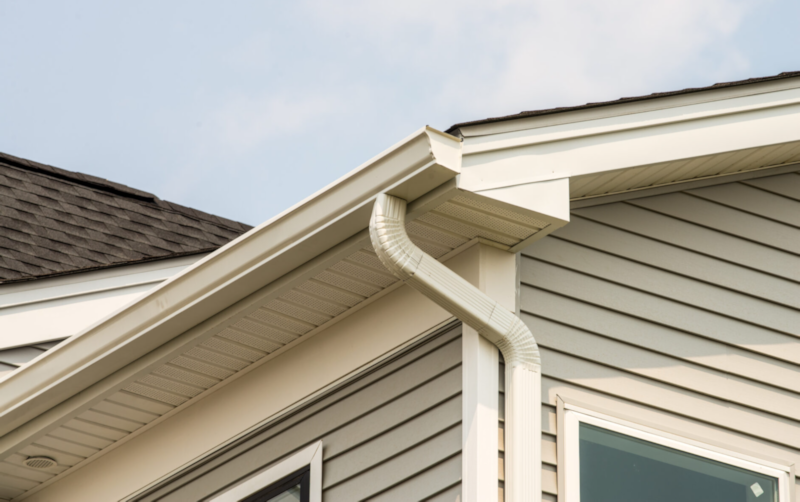
K-Style Gutters with Fluted Rectangle Downspouts
It’s a classic shape for a reason. But architecture continues to change, and new materials and building practices have made this traditional style look out of place—and, in some cases, just plain ugly. In the 30 years I’ve been installing gutters, I can’t tell you how many times I’ve heard some version of: “I really hate the look of gutters, but I need them.”
As a lifelong tradesman—one who introduces himself as The Gutter Guy even when he’s off the clock—that statement always stings.
In my profession, I’ve found that most builders I meet aren’t aware that there are many shapes of seamless gutter available. At one time there simply weren’t options, but after decades of K-style being one of the only options, the 2010s saw an explosion in manufacturing capability. Two machinery companies in particular introduced a salvo of profile after profile, giving the industry a much wider range of gutter shapes from the same style of portable roll-former we were already used to.
Despite those impressive and much-needed breakthroughs, these options didn’t gain much traction in residential construction, more on that later. Many years later, due primarily to the efforts of a small handful of people—of whom I’m proud to be one—those options are finally starting to find their way into the market.
What options exist?
Today, there are quite a few seamless gutter options, including:
K-Style — The traditional ogee shape, usually paired with fluted rectangular downspouts.
Straight-Face — A profile similar in size to K-style, but with a flat front instead of an ogee curve; often paired with smooth rectangular or round downspouts.
Fascia Gutter — A taller, narrower version of straight-face, originally designed for mounting to open rafter tails as a dual-purpose alternative to fascia.
Box Gutter — A category with many sub-styles, all featuring prominent 90-degree angles and flat faces, most often paired with smooth rectangular downspouts.
Half-Round — A half-circle trough, often mounted with external decorative brackets and round downspouts.
Rain Chains — A downspout alternative that uses linked chains or ornate cups to direct water downward in a decorative way.
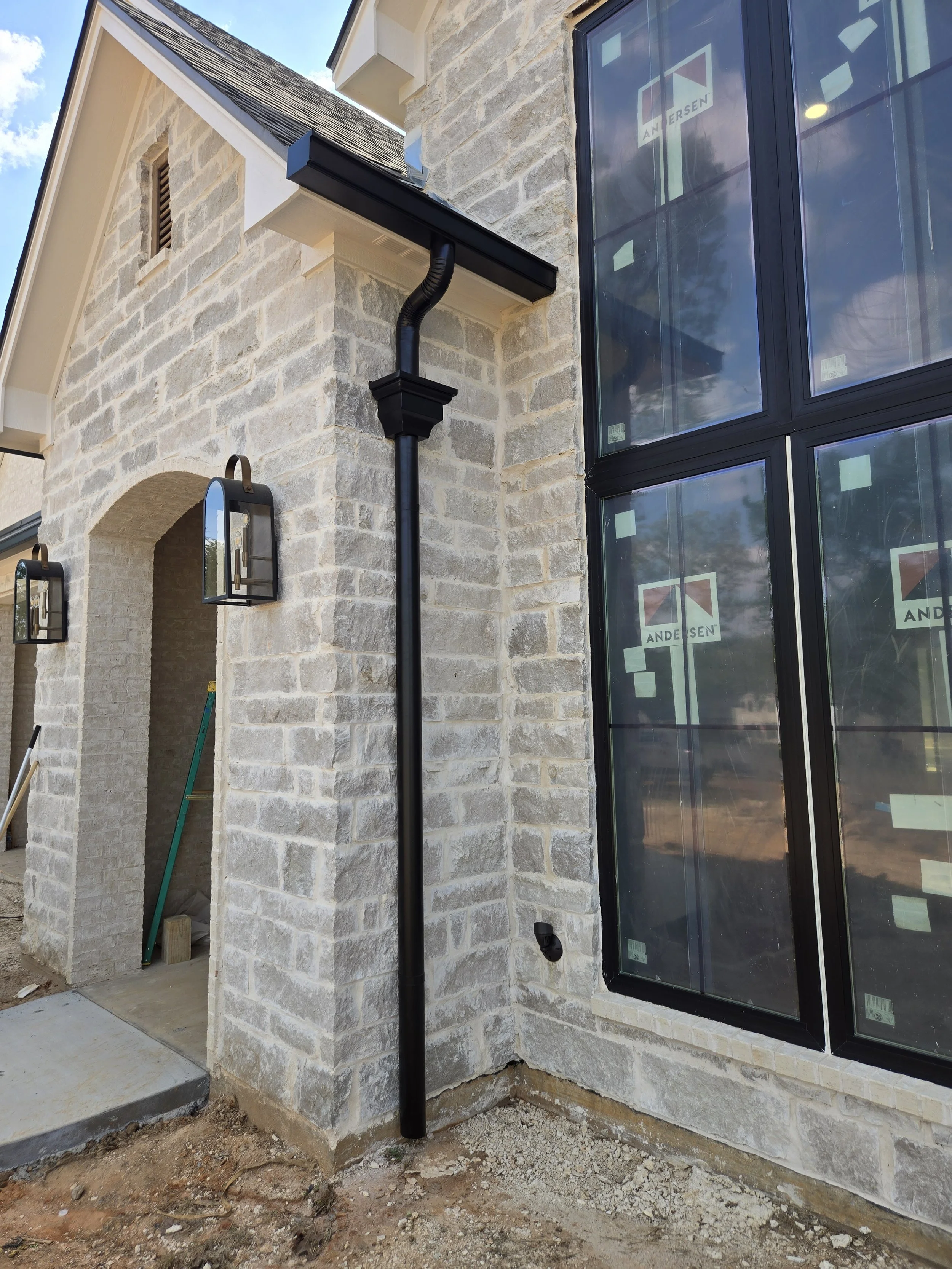
Contemporary Box
Seamless Box Gutter - Pictures with Round Downspout and Federal Conductor Head.
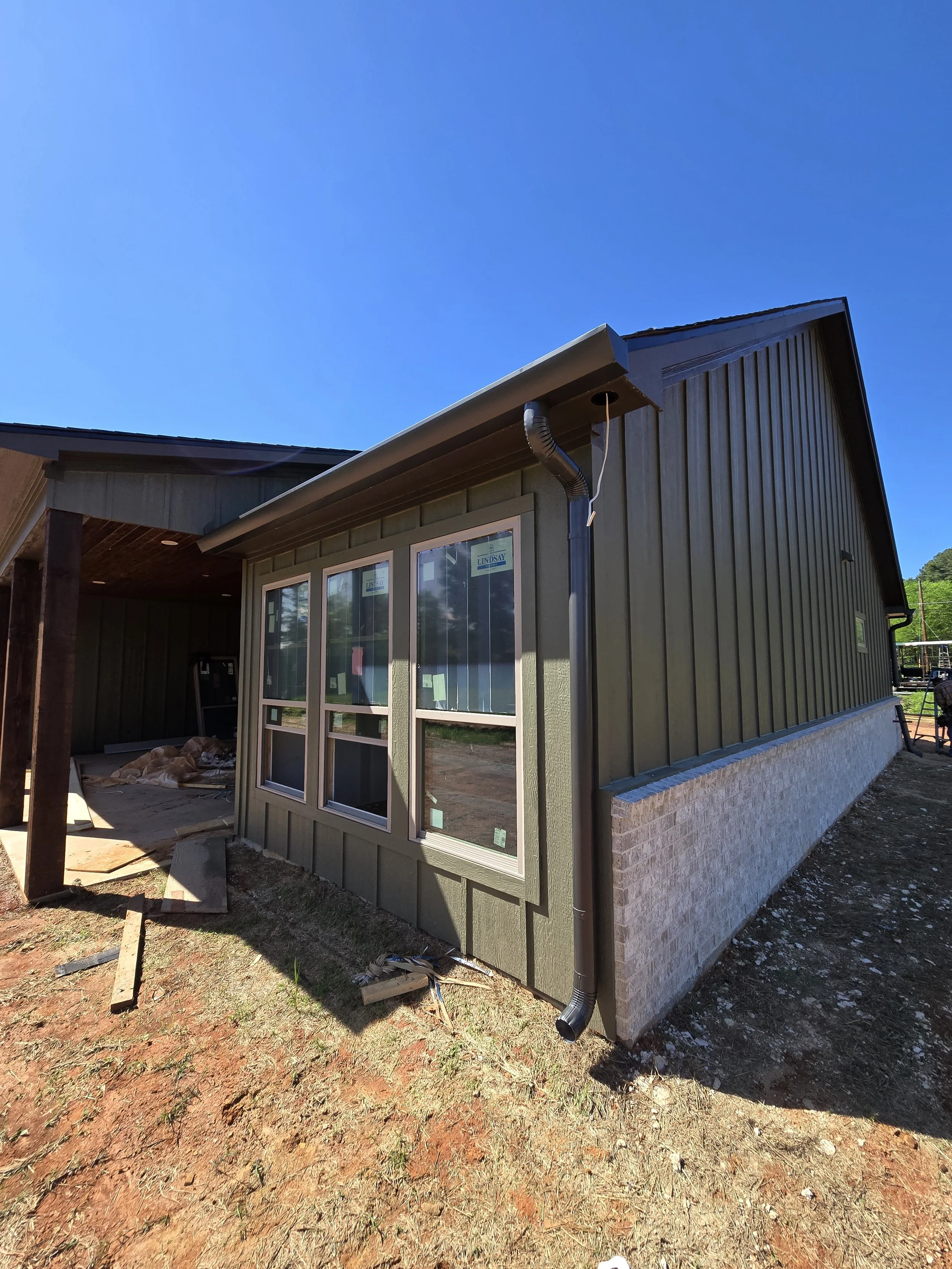
Modern Minimal
Seamless Straight Face Gutter

Classic Elegance
Seamless Half Round Gutter With External Brackets
Why would you want something other than K-style?
We aren’t building the same houses we did in the 1940s, the 1970s, or the 1990s, styles change. You are probably not putting open-bulb Hollywood vanity lights in your bathrooms or arch-panel ash cabinet doors in your kitchens anymore. Gutter should be no different.
If you’re building a modern home with single-slope rooflines, square corners, smooth-panel garage doors, and boxy hardware, why would you ruin that aesthetic with the soft curves of a K-style gutter and the rounded edges and fluting of a traditional downspout?
Even outside of larger custom homes, consider a basic low-income or multifamily build. You still need to stay on budget, but you also want curb appeal. Using a seamless box gutter and smooth rectangular downspouts, for instance, can turn a system you already need into a primary design feature.
Why haven’t we heard more about these before?
I’ve seen a few reasons for why these options aren’t more widely known and didn’t launch well.
First, there was a lack of advertising and communication within the industry. Before 2020, there were no formal gutter industry organizations and very little communication between companies. In that now almost ancient version of the trade, installer-to-installer conversation was basically nonexistent. The only way machinery manufacturers could show off new products was through supply-house pamphlets and the occasional roofing expo—events that very few gutter-only installers attended.
That changed in 2021, when an enterprising gutter installer, the late Bren Vanderswaag founded Gutter-Con, a trade convention specifically for the gutter industry. Since then, the industry has changed dramatically. We now have annual trade expos as well as several social media communities with around 10,000 members each. For the first time in the industry, a huge majority of gutter installers see new products, equipment and standards AS they are released.
Second, builders often do what they’ve always done. I was talking to an older builder recently at our local builder’s association, and he said, “I didn’t know there were other kinds of gutter. I guess I’ve just always done what I’ve always done.” I run into that sentiment often. ‘If it ain’t broke, don’t fix it!’
There is certainly value in that logic, but I would argue that using outdated products on modern projects is, in fact, something broken and worth fixing.
This is one of my favorite things about builder’s associations. The value of open dialogue, community, and conversation between companies is hard to overstate. I personally try to use every opportunity I can in my local chapter to bring samples and photos to help educate our members about options that exist, even if they are not yet common.
Third, the cost of machinery is probably the biggest factor of all. A new K-style gutter machine might cost around $15,000 in today’s market. A box or straight-face machine might cost around $22,000, and a half-round machine can exceed $36,000. That does not include the cost of a new van or trailer to house it, a new set of tools to stock the rig, or the training needed to get crews up to speed on the new product.
For an industry historically dominated by small startups and breakaway companies, money talks. Most of those companies are trying to fill an immediate need, not invest heavily in future capabilities or architecture-specific ideas.
All three of these factors have converged in such a way that, here in 2026, we’re only just beginning to see alternative gutter styles show up more often in photos, social media, and magazines.
Hey, money talks for us builders too.
There is no avoiding the bottom line. Even for custom home builders working on a flat percentage fee, budgets are still budgets.
Thankfully, cost is not always a huge obstacle when it comes to alternative gutter shapes. On the retail side of the industry, premiums can be significant. On the contractor side, however, the difference is often much less pronounced. In many cases, while it can cost more—often around 10 to 15 percent more than K-style in the contractor-to-builder market—there are also companies that charge little to no premium at all.
At my company, for instance, there is no price difference between shapes because we want to see the proper gutter profile used to fit the architecture. We may not be the norm, but others like us do exist. It’s also a good idea to talk with the gutter companies in your local builder’s association to see whether they offer discounts or upgrades for Parade Homes.
My current gutter guy is great, but he only has one style.
One thing that has happened in the gutter industry over the past decade is the growth of cut-and-drop or chop-and-drop services. In this arrangement, a gutter company that has invested in alternative profiles offers a service to run another company’s material through its machines for a small fee.
What started as a necessity has grown into its own small sub-industry, and it benefits everyone involved. If your regular gutter company does not have a specific machine, there is a good chance a cut-and-drop option exists nearby. That means you get to keep your usual subcontractor while still getting the profile you want. It also gives your regular gutter vendor a chance to test real demand before committing to a major equipment purchase.
The role of communication
Now that you know better options exist, it’s up to you to start a conversation with your subcontractors about what you want.
Rather than saying, “There’s another house I need you to go look at,” try saying, “I’ve got a modern house I need you to come look at, and I want to see what our options are to match that style.”
At gutter conventions, it’s become almost cliché to hear some version of: “My builders don’t want anything fancy, so we don’t even bring alternative styles up.” While those of us in the trade continue to push for more dialogue on our end, I hope conversations like this will start to move from both directions.
Whether you mean for it to be or not, a seamless gutter system is a very prominent feature of a build. People see it long before they ever step inside the home. When it comes time to choose gutters for your next project, I hope you’ll take a step back and consider just how important that decision really is.
Seth Forrestier
Owner, The Gutter Guy
TheGutterGuy.com
Educator, Gutter School
GutterSchool.com
Board Member, East Texas Builders Association